News & Events
Stay updated to Dreamztech's news and annoucements, and follow us to stay ahead on the courses and events that we may have from time to time.


Stay updated to Dreamztech's news and annoucements, and follow us to stay ahead on the courses and events that we may have from time to time.

Artificial intelligence is moving from the experimental stage into everyday business operations. In 2026, the most important AI developments will not simply be about larger chatbots or more impressive demonstrations. The focus is shifting toward AI systems that can take action, work across different types of data, operate inside business workflows, and produce measurable results.
The biggest AI trends 2026 will include autonomous AI agents, smaller specialised models, multimodal systems, AI-powered robotics, stronger governance, and a growing focus on the cost and energy required to run these technologies.
For businesses, the question is no longer whether AI will affect daily work. The more useful question is which AI capabilities are mature enough to adopt, and where human judgement should remain essential.
Most current AI tools respond to prompts. You ask a question, request a draft, or provide instructions, and the system generates an answer.
The next stage is more active. AI agents can plan a task, use software tools, retrieve information, make decisions within defined limits, and complete several steps without requiring a new prompt after every action.
For example, an AI sales agent could read an incoming enquiry, identify the customer’s needs, check product availability, prepare a personalised reply, update the CRM, and schedule a follow-up for a human salesperson.
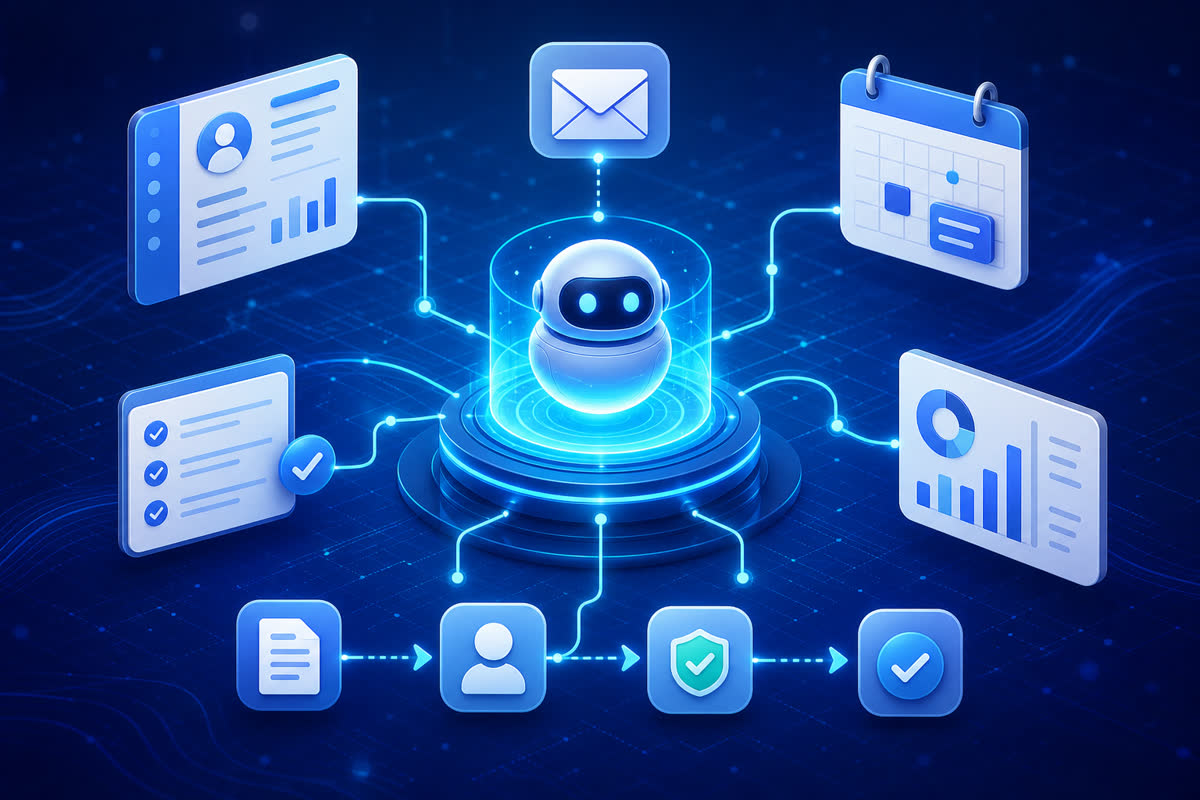
This does not mean every company will hand complete control to autonomous systems. Successful organisations will use approval checkpoints, access controls, activity logs, and clear escalation rules.
The strongest use cases will be repetitive processes with defined outcomes, including customer support triage, appointment scheduling, invoice processing, internal knowledge searches, and lead qualification. Businesses will increasingly judge AI by completed workflows rather than the quality of individual chatbot answers.
Large language models receive most of the attention, but smaller models are becoming increasingly important. A compact model can be cheaper to run, faster to respond, and easier to deploy on a private server, laptop, or mobile device. It may also be easier to customise for one industry or task.
Small specialised models can handle product classification, document extraction, customer sentiment analysis, internal search, compliance checks, voice commands, and data-entry automation. Companies will not necessarily rely on one model for everything. They may use a larger model for complex reasoning and smaller models for high-volume routine work.
This could create a layered AI architecture: a central model coordinates the workflow while specialised models handle individual tasks. For smaller businesses, the trend matters because AI adoption may become less dependent on expensive infrastructure and large technology teams.
Multimodal AI can understand and generate more than text. Depending on the system, it may process images, audio, video, documents, spreadsheets, and screen recordings in one workflow.
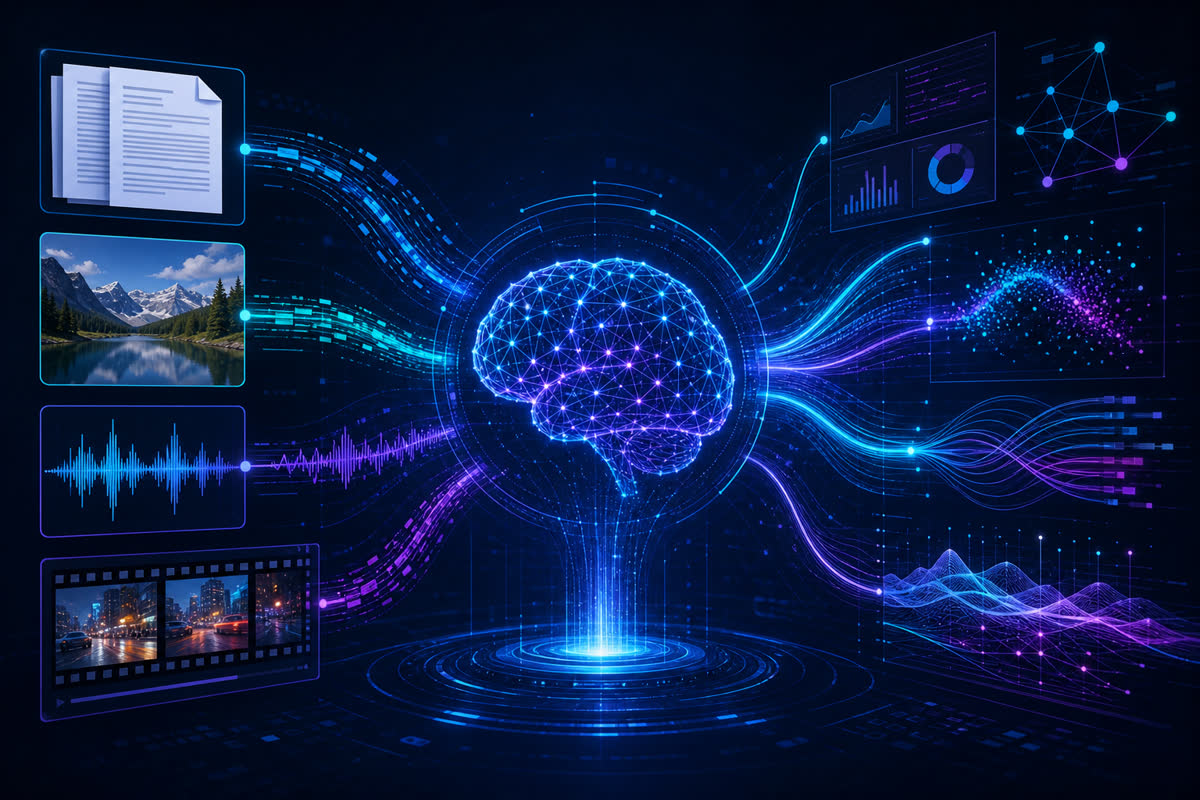
A retail company could analyse shelf images to identify stock problems. A manufacturer could review video from a production line. A property business could create a report from photographs, inspection notes, and floor plans. A support team could analyse a screen recording alongside a customer’s written complaint.
Multimodal systems will also improve accessibility. Employees may be able to speak to software, upload a photograph, or show a document instead of manually converting everything into text. However, an AI system may misunderstand a blurry image, miss important audio, or interpret a chart incorrectly. Human review remains necessary when output affects safety, money, compliance, or customer rights.
Voice interfaces are becoming faster and more natural. Businesses will continue testing AI voice agents for customer service, reservations, appointment reminders, sales qualification, and internal help desks.
A useful voice system should do more than sound human. It must understand context, recognise when it is uncertain, and transfer the conversation to a person without forcing the customer to repeat everything.
The best implementations will identify themselves as AI and provide an easy way to reach a human employee. Transparency will be important, particularly in sectors where customers may assume they are speaking to a trained professional.
Robotics has traditionally been associated with manufacturing, warehouses, and highly controlled environments. Advances in computer vision, language models, simulation, and robot learning are widening the range of possible applications.
Businesses will continue testing robots for logistics, inspection, cleaning, agriculture, healthcare support, and other physical tasks. AI can help robots interpret instructions and respond to changing conditions. Instead of programming every movement manually, operators may describe a task in natural language and allow the system to plan an approach.

Physical environments are far more complicated than digital ones. Robots must deal with uneven surfaces, unexpected objects, people, weather, and equipment failure. Deployment will therefore remain gradual and task-specific. Many organisations will first use robotics to reduce dangerous, repetitive, or physically demanding work.
AI governance is moving from a policy discussion into a practical business function. Companies will need to know which AI tools employees are using, what data those tools can access, how outputs are reviewed, whether customer information is retained, and who is responsible when a system makes a mistake.
A basic AI governance programme should include an approved tool list, data-handling rules, access permissions, human review requirements, and an incident-reporting process. This is not only about avoiding penalties. Clear boundaries can improve adoption because employees are more likely to use AI confidently when the rules are understandable.
As AI systems gain access to business data and software tools, they become more valuable targets. Risks include prompt injection, data leakage, fake audio and video, automated phishing, compromised plugins, unauthorised model access, manipulated training data, and incorrect actions taken by connected agents.
An AI agent that can send email, access a database, or change a record needs stronger controls than a chatbot that only produces text. Businesses should apply least-privilege access, require confirmation for sensitive actions, and log important outputs for review.
AI requires computing power, data centres, cooling systems, and network infrastructure. As usage grows, organisations will pay closer attention to the cost and environmental impact of running models.
This will encourage businesses to use smaller models for routine tasks, cache repeated answers, measure cost per completed workflow, and match model capability to task difficulty. The most advanced AI strategy will not be using the biggest model everywhere. It will be choosing an appropriate model for each job.
Companies preparing for these AI trends in 2026 should avoid buying tools simply because they are popular. Start with a business problem. Identify repetitive work, delays that affect customers, and processes that produce usable digital data.
Choose one workflow with a clear baseline. Measure time saved, error rates, response speed, customer satisfaction, and operating cost. Then expand only when the results are reliable. Employees should be involved early because they understand exceptions and risks that may not be visible to executives or vendors.
The most significant AI trend in 2026 will be the shift from novelty to accountability. Businesses will ask whether AI can complete a process safely, consistently, and at a reasonable cost. Customers will expect transparency. Employees will need new skills for supervising, checking, and improving automated systems.
Some AI predictions will fail. Some tools will disappear. Others will become essential infrastructure almost overnight. The organisations that benefit most will not be the ones that chase every new launch. They will be the ones that test carefully, protect sensitive data, keep humans involved where judgement matters, and connect AI projects to measurable outcomes.
AI agents are expected to be one of the most important trends because they can complete multi-step tasks rather than only generate responses. Their usefulness will depend on access controls, monitoring, and human approval.
AI is more likely to automate specific tasks than eliminate every responsibility within a job. Some roles may change significantly, while demand may grow for people who can manage, verify, and apply AI systems.
Start with one repetitive workflow, such as enquiry handling, document processing, appointment scheduling, or content repurposing. Define the expected result, protect customer data, and measure performance before expanding.
Dreamztech (M) Berhad (1297765-M)
Website Design Johor Bahru, Web Design Company Johor Bahru
| Address | 64-01 & 64-02, Jalan Molek 2/2, Taman Molek, 81100, Johor Bahru, Johor, Malaysia. |
| Phone | +6011 3503 4944 |
| sales@dreamztech.com.my |